
September 3, 2026
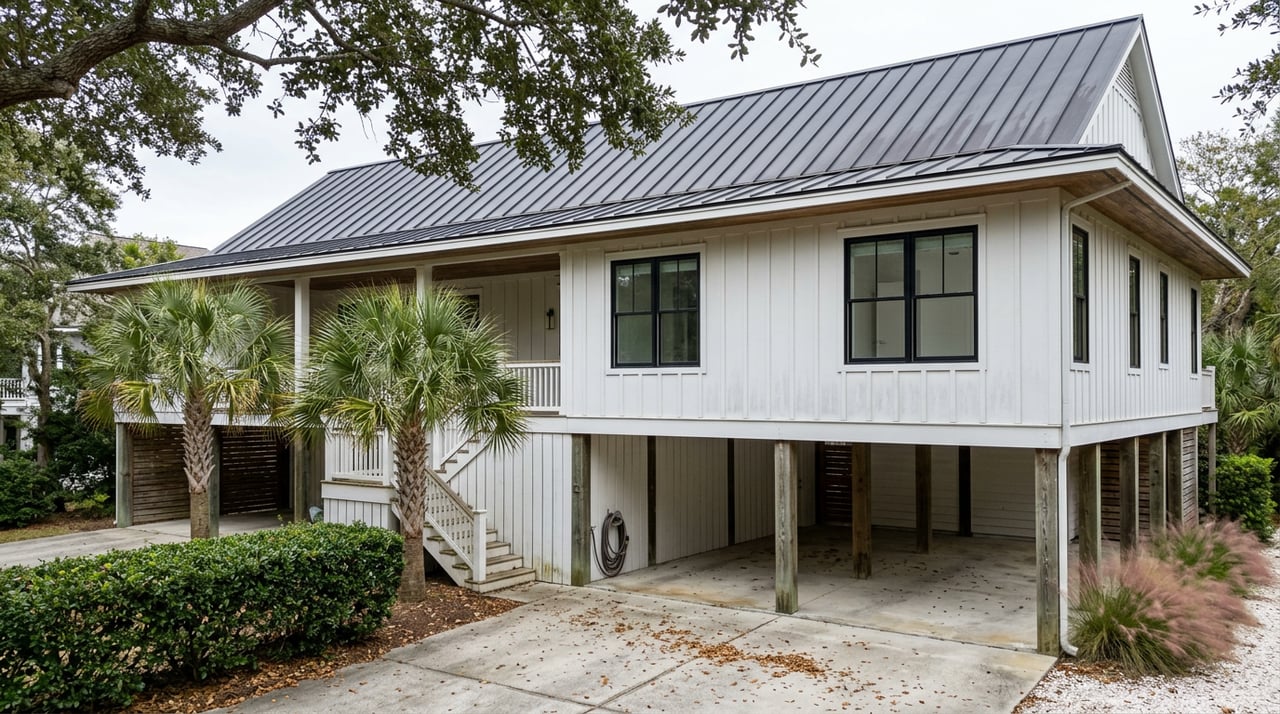
According to FEMA's case study, Don Blanchard had already rebuilt once. After Hurricane Lili and Tropical Storm Isidore chewed through his house in 2002, the retired aerospace engineer and his wife Rose tore down what was left and put up something taller, stronger, and higher off the ground. Ten months after they moved back in, Hurricane Katrina came ashore with a storm surge that FEMA later measured at 30 feet in their part of Pass Christian. When the Blanchards returned, neighbors told them their house was gone.
It wasn't. Four feet of water reached the first floor. The second floor, where the beds were still made, never got touched.
That story is not an outlier anecdote. It is the blueprint for how an entire corridor of Pass Christian rebuilt, and it explains something in the current market that does not show up if you only glance at a median price.
As of March 2026, the median price for a single-family home across Harrison County sat at roughly $231,000. Pull the zip-code data for the trailing 12 months and Pass Christian ranks among the county's highest, with a median closer to $323,000. By May 2026, though, the citywide median list price for active Pass Christian listings had climbed to $484,000, even as price per square foot had slipped about 7 percent from a year earlier and the typical listing sat on the market for 141 days.
Those three numbers do not describe one market. They describe two markets wearing the same zip code. A county-wide median, a sold-price median, and a list-price median pulling in different directions is the fingerprint of a bimodal inventory: a cluster of higher-priced listings sitting longer at the top, and a larger, faster-moving band of homes trading closer to the county norm underneath it.
The obvious explanation is water access. Homes closer to the Sound cost more, homes farther inland cost less, end of story. But that story doesn't explain why some of the priciest homes in Pass Christian also carry some of the cleanest insurance paperwork in town, while a few of the cheaper ones do not.
The split runs roughly along Scenic Drive on one side and the Espy Avenue and Interstate 10 corridor on the other, and the difference between them has less to do with the water than with the calendar.
| Scenic Drive corridor | Espy Avenue / I-10 corridor | |
|---|---|---|
| Typical construction era | Rebuilt after 2005, often to post-Katrina standards | Frequently pre-Katrina, sometimes pre-1980 |
| Rebuild trigger | Total loss in the storm forced a permit, plans review, and current-code elevation | No major damage meant no permit, no forced re-elevation |
| Flood zone exposure | Often coastal VE, the highest-hazard designation | Often AE or X, lower on paper |
| Elevation certificate | Frequently reflects current Advisory Base Flood Elevation compliance | Frequently reflects whatever code existed decades ago, if any certificate exists at all |
| Price signal | Higher list price, higher price per square foot | Lower price per square foot, often marketed as the value play |
That flood zone row is the trap. A house sitting in an inland AE or X zone looks safer on paper than a VE-zone rebuild on the water. But the zone letter tells you about the location. It does not tell you whether the specific structure was ever required to meet a modern elevation standard, and for a large share of the older inland stock, the honest answer is that it wasn't.
Before Katrina, Pass Christian's building code required the lowest floor in a floodplain to sit at least 13 feet above sea level. Katrina proved that baseline wasn't close to enough. In the months after the storm, FEMA issued Advisory Base Flood Elevations for Hancock, Harrison, and Jackson counties that pushed the required elevation three to eight feet higher than what had been on the books.
Here is the part that matters for a buyer today. That new standard only applies automatically to homes that were rebuilt or newly constructed after it took effect. A house destroyed by Katrina and rebuilt on Scenic Drive had no choice but to meet it, because rebuilding required a permit and the permit required current code. A house near Espy Avenue that Katrina spared outright never triggered that review. It sat exactly as it was built, under whatever elevation standard, or lack of one, applied when the original permit was pulled.
The federal insurance system caught up to this gap gradually. The Biggert-Waters Flood Insurance Reform Act of 2012 tightened the link between actual elevation certificates and National Flood Insurance Program premiums, moving rates away from a flat, zone-based number and toward something closer to a structure-by-structure calculation. The practical effect on the Coast is that two houses in the same flood zone, even on the same street, can carry meaningfully different premiums depending on when they were built and what elevation certificate, if any, is on file.
If you're comparing Pass Christian to another Gulf Coast town, or comparing two streets within Pass Christian, the price-per-square-foot gap is telling you about construction era and elevation compliance as much as it's telling you about distance to the water. A handful of things are worth doing before you let a listing price set your expectations:
That last point is really the whole thesis. The headline price in Pass Christian looks like it's telling you about waterfront prestige. Read one layer deeper and it's telling you about which houses had to meet today's flood standard and which ones never had to ask.
Does being in a VE flood zone automatically mean higher insurance costs than an AE or X zone? Zone matters, but elevation compliance matters more within that zone. A VE-zone home built to current Advisory Base Flood Elevation standards can price out better than an older AE-zone home without a current elevation certificate, because National Flood Insurance Program rating since the 2012 reform leans heavily on the certificate itself.
How do I find out which zone a specific Pass Christian address sits in? The FEMA Flood Map Service Center lets you search by address and pull the current Flood Insurance Rate Map panel. The City of Pass Christian's own floodplain information page is also a useful starting point for local ordinance context.
Is the gap between Pass Christian's median list price and its median sold price a sign the market is overpriced? Not necessarily. It's more likely a sign of a bimodal inventory, where a smaller number of higher-priced, longer-sitting Scenic Drive listings pull the list-side median up while the larger volume of transactions closes closer to the county norm. Worth confirming against current comps before drawing a conclusion either way.
If you're weighing a Scenic Drive rebuild against something with a lower number a few blocks inland, the elevation certificate and rebuild history will tell you more than the price tag alone. That's the kind of block-by-block read HL Raymond Properties works through with buyers and sellers across Pass Christian and the rest of the Mississippi Gulf Coast every day. Discover Gulf Coast Living, and bring your questions about a specific address before you assume the zone letter is the whole story.
This article is general information, not legal, tax or financial advice. Consult a qualified professional about your situation.


At HL Raymond Properties, your goals are our priority. Whether buying or selling, we bring strategy, care, and professionalism to every step of the process.